Overview
The University of Science and Technology – Yemen (UST) recognizes the profound link between healthy terrestrial ecosystems and sustainable community livelihoods, particularly in a country like Yemen, where land degradation, water scarcity, and desertification threaten food security and social well-being.
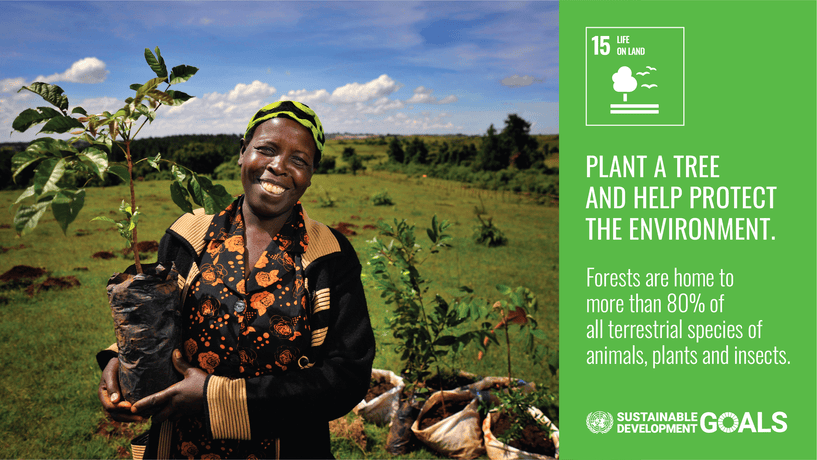
Aligned with Sustainable Development Goal (SDG) 15: Life on Land, UST’s activities in 2024 focused on:
- Environmental education and research on biodiversity, soil, and sustainable agriculture.
- Community engagement in reforestation and land restoration.
- Academic and policy collaboration with national and international institutions to promote ecosystem resilience.
Through its Faculty of Environmental and Agricultural Sciences, the Center for Environmental Studies, and community outreach programs, UST integrates teaching, research, and applied action for sustainable land management and environmental restoration.
1. Learning and Student Experience
a. Environmental and Agricultural Education
UST’s programs prepare students to address land and ecosystem challenges through:
- Bachelor’s and Master’s programs in Environmental Sciences, Agricultural Systems, and Natural Resource Management.
- Courses in Biodiversity Conservation, Soil Science, Land Use Planning, Climate-smart Agriculture, and Forestry Management.
- Student-led fieldwork on soil health, native vegetation mapping, and urban greening projects.
In 2024, more than 900 students engaged in land-related academic programs, workshops, and community projects.
b. Student Engagement and Awareness
- Green Campus Club organized the “Plant a Tree, Sustain the Future” campaign — resulting in 1,200+ native trees planted across Aden, Taiz, and Sana’a campuses.
- Field studies and workshops on soil erosion control and urban agriculture were integrated into the Environmental Science curriculum.
- World Environment Day (2024) was celebrated under the theme “Restoring Our Earth,” with exhibitions and student research presentations on land restoration.
2. Research and Innovation
a. Research Themes (2023–2025)
UST’s faculty and postgraduate researchers produced significant research aligned with SDG 15:
- “Assessment of Soil Erosion and Land Degradation in Yemen’s Highland Regions” – UST Journal of Environmental Studies (2024).
- “Biodiversity Mapping of Native Flora in Southern Yemen” – Faculty of Environmental Sciences Research Group (2024).
- “Sustainable Agriculture Techniques for Arid Lands: Yemen’s Case Study” – UST-Agricultural Research Collaboration (2023).
- “Reforestation and Carbon Sequestration Potential in Semi-Arid Zones” – Climate and Sustainability Research Center (2025).
- “Community-Based Land Rehabilitation in Post-Conflict Yemen” – in partnership with the UNDP and FAO (2024).
These studies provide data and policy insights to combat desertification and promote land resilience.
UST faculty research actively addresses challenges of land degradation, desertification, water scarcity, and biodiversity loss — key concerns under SDG 15.
| Year | Project / Publication | SDG 15 Relevance |
| 2024 | Land Degradation and Desertification in Yemen: Causes and Mitigation Approaches — UST Journal of Environmental Research | Provides data on soil erosion, vegetation loss, and sustainable land-management practices. |
| 2024 | Sustainable Agricultural Practices for Arid Regions — Faculty of Agricultural and Food Technology | Introduces climate-smart agriculture for soil fertility and yield stability. |
| 2023–2025 | Reforestation and Urban Greenery Initiatives in Sana’a — Civil and Environmental Engineering Department | Supports tree planting and urban-greening projects to enhance air quality and biodiversity. |
| 2024 | Conservation of Medicinal Plants in Yemen’s Highlands — Faculty of Pharmacy | Catalogues endangered native plants and explores conservation through biotechnology. |
| 2024 | GIS Mapping of Deforestation and Land-Use Changes in Yemen — Engineering Research Center | Applies satellite data to track deforestation and guide land-use planning. |
These studies illustrate UST’s contributions to ecosystem restoration, sustainable agriculture, and biodiversity protection, directly supporting SDG 15 targets
b. Research Collaboration and Technology
UST partners with:
- Ministry of Water and Environment – for monitoring desertification and land degradation.
- Food and Agriculture Organization (FAO) – for sustainable land and food systems research.
- UNDP Yemen – on post-conflict environmental recovery projects.
- Arab Environment Facility (AEF) – for biodiversity data exchange and ecosystem management.
In 2024, UST researchers developed GIS-based land degradation models to identify priority areas for restoration in Lahj and Aden regions.
3. Sustainable Campus Operations
a. Green Campus and Biodiversity
- UST’s campuses integrate green design principles, including native plant landscaping, reduced water irrigation, and soil health monitoring.
- Biodiversity Gardens were established at Aden and Taiz branches featuring native flora and medicinal plants for research and conservation.
- The university introduced composting systems using organic campus waste, producing soil fertilizer for the Green Campus Project.
b. Waste Management and Environmental Impact
- The Zero Waste to Landfill initiative (2024) reduced organic and paper waste by 65%, minimizing the university’s land pollution footprint.
- Laboratories implemented eco-safe waste disposal protocols, preventing chemical contamination of soil and groundwater.
4. Community Engagement and Environmental Restoration
a. Reforestation and Land Restoration
UST’s Community Service and Environmental Outreach Center launched multiple initiatives:
- “Greening Yemen” Project (2024):
- Planted over 3,000 trees in partnership with the Aden Municipality, FAO Yemen, and local schools.
- Focused on restoring degraded urban and rural landscapes.
- Students and volunteers contributed more than 3,000 working hours.
- Soil Conservation Workshops:
- Conducted in collaboration with the Ministry of Agriculture.
- Focused on sustainable irrigation, terracing restoration, and water-harvesting techniques.
- Biodiversity Conservation Training:
- Delivered to local farmers and youth groups on native species protection and integrated pest management.
b. Public Education and Awareness
- UST held a national symposium on “Land, Food, and Sustainability” (2024) — bringing together scientists, policymakers, and NGOs.
- Community seminars on deforestation prevention, urban greening, and climate-smart farming reached over 2,000 participants.
5. Partnerships and Policy Engagement
UST promotes land and ecosystem sustainability through multi-level collaboration:
- National Partners: Ministry of Environment, FAO, UNDP, and local municipalities.
- Academic Partners: Aden University, Hadhramout University, and international environmental research institutes.
- Civil Society Organizations: Green Yemen Initiative, Resilient Earth Network.
These partnerships ensure UST’s research and outreach contribute to national policies and global environmental frameworks, particularly under the UNCCD (UN Convention to Combat Desertification).
6. Performance Indicators (2024)
| Indicator | 2024 | Progress / Description |
| Land-related research publications | 17+ | Interdisciplinary studies expanded through grants. |
| Trees planted through UST initiatives | 5,200+ | Expanded reforestation and campus greening. |
| Community outreach participants | 2,000+ | Increased engagement via training and awareness. |
| Partnerships for ecosystem restoration | 7 | Including FAO, UNDP, AEF, and local municipalities. |
| Organic waste composted on campus (%) | 65% | Significant reduction in land waste. |
| Student research projects on land/soil | 35+ | Field-based research and capstone projects. |
| Areas restored or planted (hectares) | 15+ | Documented under “Greening Yemen” campaign. |
7. Case Studies
Case Study 1 – “Greening Yemen” Reforestation Project
UST’s flagship land restoration initiative launched in 2024 focused on combating desertification and promoting community awareness.
Highlights:
- 5,000+ native trees planted.
- Collaboration with FAO, Aden Municipality, and local NGOs.
- Included student training on nursery management and irrigation systems.
- Positive community feedback and media coverage on local TV and Al-Ayyam Newspaper.
Case Study 2 – “Sustainable Agriculture in Arid Environments” Research
- Multidisciplinary research integrating environmental science, economics, and engineering.
- Developed models for low-cost drip irrigation and soil nutrient regeneration using composting.
- Pilot implementation with farmers in Lahj region improved crop yield by 22%.
Case Study 3 – “Zero Waste to Landfill” Campus Policy
- Initiated by UST Environmental Unit (2024).
- Reduced landfill waste by 65% through composting, paper recycling, and plastic elimination.
- Transformed waste into organic fertilizers for tree-planting programs.
8. SDG Linkages
| Linked SDG | Connection |
| SDG 2 – Zero Hunger | Promotes sustainable agriculture and soil fertility. |
| SDG 6 – Clean Water and Sanitation | Supports watershed management and water-efficient farming. |
| SDG 13 – Climate Action | Increases carbon sequestration via reforestation. |
| SDG 14 – Life Below Water | Reduces terrestrial runoff pollution impacting marine systems. |
| SDG 17 – Partnerships for the Goals | Expands global collaboration on land restoration. |
9. Future Outlook (2025 Targets)
- Launch a National Center for Land and Biodiversity Research.
- Increase reforestation coverage to 10,000 trees annually.
- Expand student environmental internships in collaboration with FAO and UNDP.
- Publish 20+ peer-reviewed papers on land degradation and restoration.
- Develop GIS-based desertification risk maps for southern Yemen.
- Integrate sustainable agriculture innovation labs across campuses.
10. Conclusion
The University of Science and Technology – Yemen has established itself as a leader in environmental education and terrestrial ecosystem management in the region.
Through its academic programs, innovative research, and community partnerships, UST contributes meaningfully to restoring degraded lands, conserving biodiversity, and advancing sustainable land use practices.
Despite Yemen’s ecological challenges, UST’s proactive initiatives — such as “Greening Yemen”, Zero Waste Campus, and land restoration research — demonstrate measurable impact and long-term commitment to achieving SDG 15: Life on Land.