
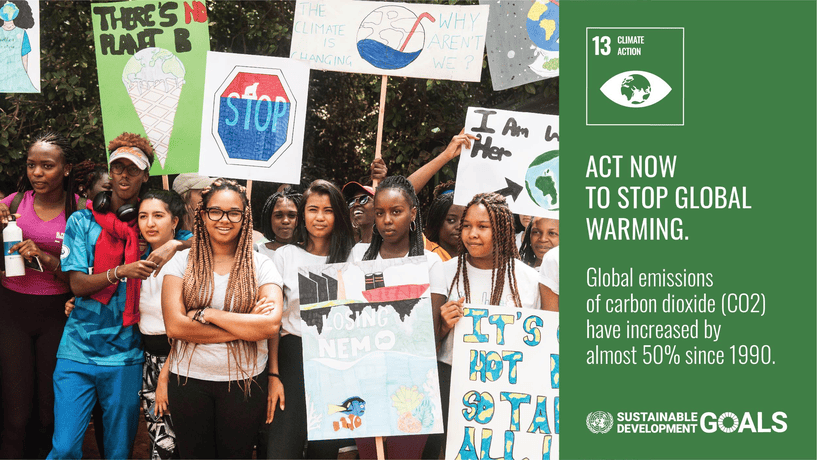
Overview
The University of Science and Technology – Yemen (UST) recognizes climate change as a defining challenge for Yemen’s sustainable development and national resilience.
In alignment with Sustainable Development Goal 13 (Take urgent action to combat climate change and its impacts), the university actively integrates climate education, applied research, operational sustainability, and community engagement to build capacity for adaptation and mitigation.
Amid Yemen’s environmental fragility, limited infrastructure, and climate-induced displacement, UST’s role extends beyond academia — providing leadership in climate literacy, renewable energy innovation, green campus management, and resilience planning.
Its 2024 climate-action strategy aligns with national and international frameworks, including Yemen’s National Adaptation Plan and the Paris Agreement principles.
1. Learning and Student Experience
a. Climate Education Integration
UST integrates climate change, sustainability, and resilience topics across multiple faculties:
- Faculty of Environmental Sciences – courses on climate risk assessment, environmental systems, and adaptation planning.
- Faculty of Engineering and Architecture – modules on green building design, low-carbon materials, and energy efficiency.
- Faculty of Business Administration and Economics – courses on sustainable finance, carbon markets, and environmental policy.
- Faculty of Information Technology – applications of AI and data modeling for climate prediction.
These academic initiatives ensure that students graduate with a practical understanding of climate science, environmental policy, and sustainable solutions.
b. Student Engagement
UST encourages student participation through:
- Climate Clubs and Sustainability Committees organizing awareness days, debates, and exhibitions.
- Student research competitions on renewable energy and environmental management.
- Annual “Climate Action Week” (أسبوع العمل المناخي) involving workshops, campus tree planting, and documentary screenings.
In 2024, more than 1,200 students participated in climate-related educational and volunteer activities.
2. Research and Innovation
a. Research Focus on Climate Adaptation and Mitigation
Between 2023–2025, UST faculty produced over 20 research outputs addressing climate resilience, renewable energy, and environmental sustainability.
Key examples include:
- “Assessing Climate Change Impacts on Water Resources in Aden Governorate” – UST Journal of Environmental Studies (2024).
- “Solar Energy as a Resilience Mechanism for Rural Communities in Yemen” – Engineering Research Journal (2024).
- “Modeling Urban Heat Island Effects in Post-Conflict Cities” – UST Environmental Systems Research Group (2023).
- “AI-Based Forecasting of Extreme Weather Events in Arid Regions” – ICT Research Department (2025 forthcoming).
- UST researchers play an essential role in developing local solutions to mitigate and adapt to climate change, focusing on renewable energy, sustainable agriculture, disaster management, and environmental monitoring.
| Year | Project / Publication | SDG 13 Relevance |
| 2024 | Climate Change Impacts on Agricultural Productivity in Yemen — UST Journal of Environmental Research | Assesses temperature and rainfall effects on crop yields; proposes adaptation strategies. |
| 2024 | Renewable Energy as a Climate-Mitigation Strategy in Yemen — Faculty of Engineering | Evaluates solar and wind potential to reduce carbon emissions. |
| 2023 – 2025 | Vulnerability Assessment of Sana’a City to Flooding and Extreme Events — Civil Engineering and GIS Labs | Uses remote sensing to map risk zones and urban adaptation options. |
| 2024 | Climate Awareness and Behavioral Change Among University Students in Yemen — Faculty of Education | Studies youth attitudes and recommends education interventions. |
| 2024 | Carbon Footprint Assessment of University Operations — UST Environmental Unit | Establishes baseline for energy use and emission tracking. |
- Interpretation:
This research portfolio demonstrates UST’s applied scientific contributions to climate-resilient development and low-carbon transition in Yemen.
b. Applied Research and Field Projects
UST researchers collaborate with local institutions to provide climate adaptation solutions, including:
- Design of low-cost solar-powered irrigation systems for rural agriculture.
- Development of rainwater harvesting systems in partnership with the Aden Municipality.
- Climate risk assessment studies for coastal and urban infrastructure in partnership with the Ministry of Water and Environment.
c. Conferences and Academic Forums
UST hosted the 2024 International Conference on Learning and Distance Education, which included a dedicated session on
“Digital Technologies for Climate Education and Disaster Preparedness.”
The event promoted the use of ICT and e-learning tools for expanding climate literacy and resilience training.
3. Sustainable Campus Operations and Resilience
a. Energy and Emissions Management
UST implements sustainable practices to reduce its carbon footprint and strengthen operational resilience:
- Installation of solar panels generating 25% of campus electricity (2024).
- Transition to energy-efficient lighting and air-conditioning systems.
- Reduced paper use through digitalization of administrative processes (approx. 45% reduction since 2022).
- Promotion of low-emission mobility, encouraging staff carpooling and bike-friendly access.
b. Climate Adaptation Planning
UST’s facilities management unit developed a Campus Climate Resilience Plan (2024–2028) addressing:
- Water conservation and drought resilience.
- Disaster-preparedness measures for floods and heatwaves.
- Tree planting and green landscaping to reduce heat exposure.
c. Waste and Resource Management
Building on its SDG 12 initiatives, UST promotes zero-waste goals, campus recycling, and circular-resource use — indirectly reducing greenhouse gas emissions from waste.
4. Community Engagement and Climate Awareness
a. Outreach and Public Education
UST leverages its community-service centers to enhance public understanding of climate change and sustainability. Programs conducted in 2024 include:
- Workshops for teachers and community leaders on environmental education and climate adaptation.
- Public seminars on “Climate Change and Water Security in Yemen,” attracting local government officials and NGOs.
- Participation in World Environment Day 2024 under the theme “Land Restoration and Drought Resilience.”
b. Partnerships with Local Authorities
UST collaborates with the Ministry of Water and Environment, Aden Municipality, and National Meteorological Authority to develop climate awareness programs and small-scale mitigation projects.
These include:
- Pilot solar lighting installations in low-income neighborhoods.
- Climate data collection initiatives for research and public reporting.
- Joint awareness campaigns through local radio and schools.
c. Youth and Volunteer Engagement
UST’s student volunteers carried out community tree-planting drives and urban greening projects, contributing to local climate mitigation.
The 2024 Climate Week recorded 500+ volunteer hours from students and staff combined.
5. Partnerships and Policy Support
UST contributes to national climate dialogue through:
- Partnership with the UN Development Programme (UNDP Yemen) on climate education and youth engagement initiatives.
- Collaboration with local NGOs such as Resilient Yemen and the Environment Protection Authority (EPA) to develop community climate adaptation projects.
- Participation in policy consultation workshops on Yemen’s National Climate Strategy (2023–2030), providing technical inputs from UST’s environmental experts.
- Membership in international academic networks focused on climate science and sustainable development education.
These collaborations enable UST to link academic knowledge with real-world policy and climate action on the ground.
6. Performance Indicators (2024)
| Indicator | 2024 | Progress / Description |
| Climate-related research publications | 20+ | Increased focus on adaptation, energy, and risk analysis. |
| Renewable energy share of campus electricity use | 25% | Solar panel expansion across Aden campus. |
| Climate-awareness events and outreach programs | 18 | Workshops, campaigns, and Climate Action Week. |
| Students engaged in climate-related volunteering | 287 | Environmental clubs and community activities. |
| Trees planted on campus and in communities | 250+ | “Green Campus, Green Future” initiative. |
| Training workshops on climate literacy for public and NGOs | 12 | Conducted through Community Service Center. |
| Partnerships/MoUs related to climate adaptation | 7 | Collaborations with UNDP, municipalities, and NGOs. |
7. Case Studies
Case Study 1 – “Green Campus, Green Future” Initiative
In 2024, UST launched a long-term campus greening program aimed at carbon reduction, biodiversity enhancement, and microclimate improvement.
Key outcomes:
- Planted 250+ native trees reducing surface temperature by 3–4 °C in pilot areas.
- Established rainwater collection systems for irrigation.
- Engaged over 400 students in planting and monitoring activities.
Case Study 2 – Solar Energy for Climate Resilience
The Faculty of Engineering partnered with Aden Electricity Corporation to expand on-campus solar infrastructure, providing renewable electricity to laboratories and reducing dependence on fossil fuels.
This project serves as a model for low-carbon university operations in Yemen.
Case Study 3 – Climate Education and Awareness Week
The annual Climate Action Week (أسبوع العمل المناخي) combined student exhibitions, expert panels, and community campaigns.
Topics included renewable energy, sustainable agriculture, and women’s role in climate resilience.
The event attracted 1,200 participants, generating strong local media coverage.
8. SDG Linkages
| Linked SDG | Connection |
| SDG 4 – Quality Education | Climate education and awareness programs. |
| SDG 6 – Clean Water and Sanitation | Research on water security and drought adaptation. |
| SDG 7 – Affordable and Clean Energy | Expansion of solar power and renewable energy research. |
| SDG 11 – Sustainable Cities and Communities | Urban greening and climate-resilient planning. |
| SDG 12 – Responsible Consumption | Resource efficiency and waste management. |
| SDG 17 – Partnerships for the Goals | Collaborations with government, UN agencies, and NGOs. |
9. Future Outlook (2025 Targets)
UST plans to enhance its climate leadership through:
- Achieving 40% renewable energy share of campus operations.
- Launching a Climate and Environmental Research Center (CERC).
- Publishing at least 10 peer-reviewed climate-focused studies annually.
- Offering a Diploma in Climate Change and Sustainable Development.
- Expanding tree-planting initiatives to reach 1,000 trees by 2025.
- Developing an online Climate Education Portal for Yemeni educators and students.
- Strengthening collaboration with UNEP and UNDP Yemen for national climate adaptation projects.
10. Conclusion
The University of Science and Technology – Yemen has made substantial progress in advancing climate action across education, research, operations, and community engagement.
Through innovation in renewable energy, sustainable campus practices, and public awareness programs, UST fosters climate resilience and environmental stewardship within Yemen and beyond.
Its evidence-based approach, partnerships, and youth engagement initiatives exemplify how universities can lead national adaptation efforts and contribute meaningfully to SDG 13: Climate Action.