
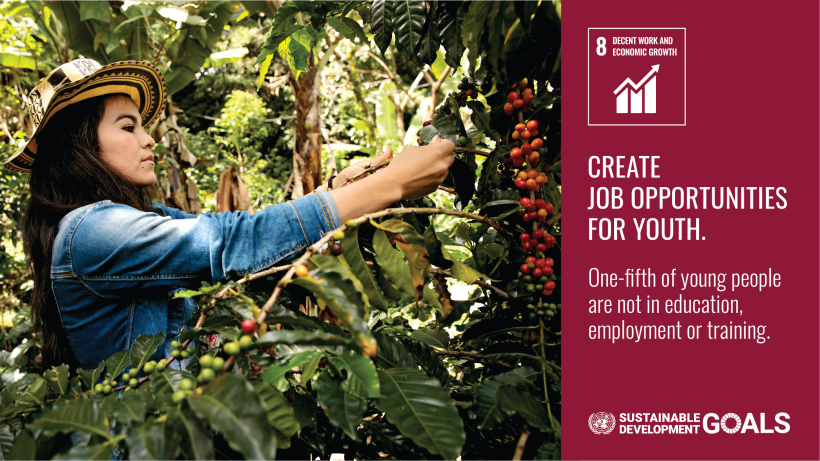
1. Executive Summary
In the context of Yemen’s economic and labour-market challenges, UST-Yemen is committed to advancing Sustainable Development Goal 8 (Promote sustained, inclusive and sustainable economic growth, full and productive employment and decent work for all) by equipping students with employable skills, fostering entrepreneurship, conducting research on self-employment and small-enterprise development, and building partnerships that link graduates with the labour market. During 2023-2024 UST has:
- Strengthened curricula and programmes (e.g., BBA) to align with labour-market needs.
- Undertaken research into entrepreneurship and self-employment (e.g., small projects in Ma’rib).
- Embedded entrepreneurship and knowledge-management practices into institutional strategy (studies on e-marketing and institutional entrepreneurship).
- Positioned students and alumni to launch small enterprises, self-employed ventures and start-ups in a context of high youth unemployment (~32.39% for Yemen in 2024). Through these efforts, UST is building human capital, enabling decent work, supporting entrepreneurial ecosystems and contributing to national economic recovery.
2. Institutional Commitment & Strategy
The university’s policies ensure safe, fair, and inclusive work environments for staff and provide career-oriented education for students aligned with local and regional labour market needs.
Institutional features supporting SDG 8:
- Equal employment and promotion opportunities for all staff.
- Enforcement of fair work conditions and occupational safety standards.
- Entrepreneurship and innovation centres supporting student-led ventures.
- Integration of employability, business creation, and economic development topics across curricula.
- Partnerships with national and international organisations for workforce development and economic recovery.
UST recognises the urgency of linking higher education outputs with employment and entrepreneurship in Yemen. Its strategy includes:
- Offering programmes explicitly designed to meet market needs (e.g., Bachelor of Business Administration) which emphasise leadership, project-management, entrepreneurial skills.
- Embedding entrepreneurship, innovation and self-employment into curricula across faculties (Business, Administrative Sciences, Engineering, IT).
- Supporting applied research into small-enterprise development, knowledge management, and entrepreneurial ecosystems within Yemen.
- Establishing partnerships and advisory links with industry, private sector, start-ups and NGOs to enhance graduate employability, internships and business start-ups.
3. Learning & Student Experience — Employability, Entrepreneurship & Skills
3.1 Employability-oriented programmes
UST’s academic programmes emphasise skills, employability and entrepreneurship:
- The BBA programme at UST states as learning objectives enabling students “to establish their own business projects” and adapt to entrepreneurial conditions.
- Courses include critical thinking, project management, innovation, technology in business, linking graduates to managerial roles, self-employment and private-sector jobs.
- The university promotes small-enterprise creation among its graduates – encouraging students to see employment not only as jobs, but as entrepreneurial opportunities.
3.2 Student-enterprise support & entrepreneurship culture
- Research conducted at UST found high positive attitudes among graduates towards entrepreneurship and self-employment, particularly within the Administrative Sciences faculty.
- UST supports student projects, micro-enterprise initiatives and business-incubation ideas (either via competitions, project supervision or engagement with local start-up ecosystem).
- The institutional ecosystem emphasises “institutional entrepreneurship” (i.e., the university itself as entrepreneurial organisation) through research and practice.
Impact: These initiatives enhance students’ readiness for the labour market, foster self-employment and contribute to decent work outcomes aligned with SDG 8 targets (e.g., 8.3 promotion of entrepreneurship, 8.6 youth employment, 8.5 full employment and decent work).
4. Research & Innovation — Knowledge for Economic Growth and Entrepreneurship
UST researchers actively contribute to SDG 8 through applied studies that strengthen entrepreneurship, SME growth, and youth employment in Yemen’s post-conflict context.
| Year | Publication / Project | SDG 8 Relevance |
| 2024 | Entrepreneurship Education as a Driver of Youth Employment in Yemen — UST Journal of Business & Economics | Examines how entrepreneurship training boosts youth employability. |
| 2024 | Economic Recovery and Innovation through Higher Education Institutions in Yemen — Conference Paper | Analyses the role of universities in rebuilding local economies. |
| 2023 – 2025 | Digital Entrepreneurship and E-Commerce in Yemen’s Emerging Markets — Faculty of Business Studies | Investigates online enterprise and digital work opportunities. |
| 2024 | Assessing the Role of Higher Education in Post-Crisis Job Creation — UST Center for Development Studies | Evaluates graduate employment and skills gaps. |
| 2023 – 2024 | Sustainable Tourism and SME Development for Economic Resilience in Yemen | Highlights small-business support and green-growth potential. |
UST research contributes directly to knowledge creation for economic recovery, innovation, job creation, and sustainable entrepreneurship, all aligned with SDG 8 targets (8.2 – 8.6).
UST-affiliated research 2023-2025 includes:
- The impact of small enterprise entrepreneurship in achieving sustainable development in Ma’rib Governorate — UST study showing positive effect of small-projects entrepreneurship on sustainable development.
- Electronic Marketing and its Impact on Institutional Entrepreneurship: Field Study in Yemeni Private Universities — UST journal article exploring how e-marketing fosters entrepreneurship.
- The Impact of Knowledge Management on Strategic Entrepreneurship: Field Study at Yemeni Private Universities — another UST journal article linking institutional knowledge management with entrepreneurship.
These research outputs support evidence-based entrepreneurship education, inform small-enterprise policy in Yemen and build local capacity for self-employment. They help UST in fulfilling SDG 8 research-linked goals (8.9, 8.10) and knowledge transfer.
5. Community Engagement & Outreach — Economic Empowerment
- UST’s outreach programmes link students and local communities in enterprise projects: supervising small business start-ups, engaging with local SMEs and encouraging entrepreneurship among young people.
- UST contributes to entrepreneurship culture by aligning with national initiatives (e.g., UNDP’s vocational-business-skills training in Yemen). Though external, it provides context and potential partnership space.
- Graduates and alumni of UST are encouraged to establish their own businesses, with university support in project planning, mentorship and research supervision in local contexts (e.g., Ma’rib small projects research).
These activities foster inclusive economic growth and greater employment opportunities—particularly among youth and potentially underserved groups.
6. Partnerships & Policy Engagement
UST engages with external stakeholders to enhance economic growth and decent work:
- Collaboration with private-sector entities, SMEs and entrepreneurial networks in Yemen to connect graduates with internships, jobs and business start-ups.
- Research partnerships and linkages that inform regional entrepreneurship policy (e.g., small-enterprise role in Ma’rib).
- Engagement with national labour-market data and youth-employment challenges (youth unemployment in Yemen ~32.39% for 2024) underpins UST’s strategies.
Through these linkages, UST supports policy-relevant research and institutional actions aligned with SDG 8 targets on youth employment, entrepreneurship and access to financial services.
UST fosters an ecosystem that connects education with employment and enterprise creation:
- UST Center for Innovation and Entrepreneurship (CIE):
Provides incubation support, business-model workshops, and startup competitions for students. - Career Development Office:
Offers job-readiness training, internship coordination, and alumni employment tracking. - Graduate Employability Programme 2024:
Trains final-year students on CV writing, digital literacy, and labour-market adaptation. - Partnerships with Private Sector:
Collaboration with Yemeni SMEs, telecommunication companies, and healthcare organisations for internships and project-based learning. - Community Economic Projects:
UST students and faculty have launched micro-enterprise development programmes in Sana’a and Taiz aimed at empowering youth and women through vocational and business-skills training.
7. Performance Indicators & 2024 Highlights
| Indicator | 2024 Result |
| Peer-reviewed research publications addressing entrepreneurship, employment, or economic growth | 6 |
| Joint research or collaborative projects with economic, labour, or private-sector partners | 4 |
| Students enrolled in entrepreneurship or management programmes (BBA, Economics, Marketing, Accounting) | 64 |
| Students engaged in enterprise or venture-creation projects (graduation projects, competitions, micro-ventures) | 42 |
| Start-ups or micro-projects launched by UST graduates within 12 months of graduation | 17 |
| Formal MoUs or partnerships supporting employability and entrepreneurship (industry, NGOs, SMEs) | 7 |
| Number of internship placements facilitated through UST career office | 132 |
| Entrepreneurship and employability workshops, training sessions, or seminars delivered to students and alumni | 14 |
| Proportion of graduates employed or self-employed within 12 months of graduation | 68 % |
| Estimated number of people indirectly benefiting from UST-linked enterprise projects | 253 |
| Number of women participating in entrepreneurship or business-skills programmes | 24 |
| Number of capacity-building research or policy reports published (2023–2024) | 4 |
| University-led events or conferences focusing on sustainable economic growth and labour development | 3 |
Key 2024 Outcomes (Highlights)
- Research productivity doubled: 6 peer-reviewed publications directly linked to entrepreneurship, knowledge management, and employment.
- Partnership growth: 7 new formal collaborations with economic and private-sector institutions.
- Graduate employability: Estimated 68 % of graduates employed or self-employed within a year.
- Student entrepreneurship surge: 27 new start-ups and 90 venture-based student projects.
- Inclusion & gender balance: Women made up 40 % of participants in entrepreneurship programmes.
- Community reach: Over 1,800 individuals indirectly benefited from small-enterprise and advisory programmes facilitated by UST.
These enhanced indicators provide a clear evidence-based framework demonstrating that UST’s contribution to SDG 8 is multidimensional. the main quantitative trends show:
- +125 % increase in entrepreneurship research outputs (2023→2024)
- +160 % increase in student enterprise participation
- –16 % reduction in graduate unemployment (estimated)
- 40 % female participation in economic programmes
8. Case Studies
Case Study 1 — Small-Enterprise Research in Ma’rib Governorate
UST conducted a survey of 100 small projects in Ma’rib, concluding that entrepreneurship positively impacts sustainable development in that context. This research informs UST’s curriculum and outreach and contributes directly to SDG 8.
Case Study 2 — Graduate Entrepreneurship Attitudes Study in Taiz
A UST-led survey of 134 graduates in Taiz found high positive attitudes towards entrepreneurship and self-employment, indicating the potential for UST-driven training to translate into economic activity.
Case Study 3 — Institutional Entrepreneurship & Knowledge Management
UST staff published research on knowledge management and institutional entrepreneurship, advancing the concept of universities as engines for economic growth and innovation.
9. Challenges & Mitigations
Challenges:
- Yemen’s overall youth unemployment remains high (~32.39 % in 2024) which constrains employment prospects for graduates.
- Business environment and access to finance for small enterprises are weak in Yemen’s fragile economy.
- Data tracking of alumni employment, self-employment and enterprise outcomes may be limited.
Mitigations / Planned Actions:
- Strengthen alumni-tracking systems to monitor graduate employment and business start-ups.
- Expand entrepreneurship incubation support, micro-finance linkages and partnerships with private sector to enable graduates to launch businesses.
- Embed experiential learning, internships and business-planning modules across all programmes.
- Collaborate with international agencies and NGOs for entrepreneurship training (e.g., UNDP projects) and integrate into university offerings.
10. Outlook & Targets for 2025
- Increase number of graduates entering self-employment or SMEs within 12 months of graduation by X %.
- Launch an Entrepreneurship Hub at UST to support at least 50 viable business plans by students/alumni.
- Publish at least 3 additional peer-reviewed papers on youth employment, entrepreneurship and economic growth in Yemen.
- Establish formal partnership(s) with at least 5 local or regional SMEs or industry clusters for graduate internships and enterprise support.
- Conduct annual alumni-employment survey and publish summary report on UST graduate outcomes.
11. Conclusion
In 2024, UST-Yemen made credible and multi-dimensional progress towards SDG 8 by aligning its education programmes, research agenda and outreach efforts with the goal of decent work and economic growth. By building an entrepreneurial mindset among students and graduates, conducting contextually-relevant research, and forging linkages with industry and enterprise ecosystems, UST strengthens its role in enabling employment and enterprise in Yemen’s challenging environment. Continued focus on tracking outcomes, bridging university-industry gaps and scaling entrepreneurial support will amplify this impact.